Copper peptide is one of the busiest ingredients in cosmetic raw-material sourcing, and 2026 brought a document that changes how buyers can talk about it. NMPA published YY/T 10005—2026, Cosmetic Raw Materials — Copper Tripeptide-1, on 3 April 2026; it takes effect on 1 May 2027 as a voluntary industry standard.
That gap is the useful part. Before the effective date, the standard's practical value is not certification — it is a shared vocabulary for supplier qualification and goods-receipt acceptance. This article works from an internal test summary of six anonymized samples dated 2026-08-11, and keeps three things apart: what the standard requires, what the data shows, and what neither can settle.
1. YY/T 10005—2026 at a glance: published, not yet in force
The standard applies to copper tripeptide-1 (Copper Tripeptide-1, commonly GHK-Cu) and its salts used as cosmetic raw materials. It splits quality control across appearance and odor, identification, copper tripeptide-1 / tripeptide-1 / copper content, purity, pH, moisture, acetic acid, microbiology and hazardous substances, and also covers packaging, transport, storage and shelf life.
| Standard number | YY/T 10005—2026 |
| Title | Cosmetic Raw Materials — Copper Tripeptide-1 |
| Published | 2026-04-03 |
| Effective | 2027-05-01 |
| Type | Voluntary industry standard (not mandatory) |
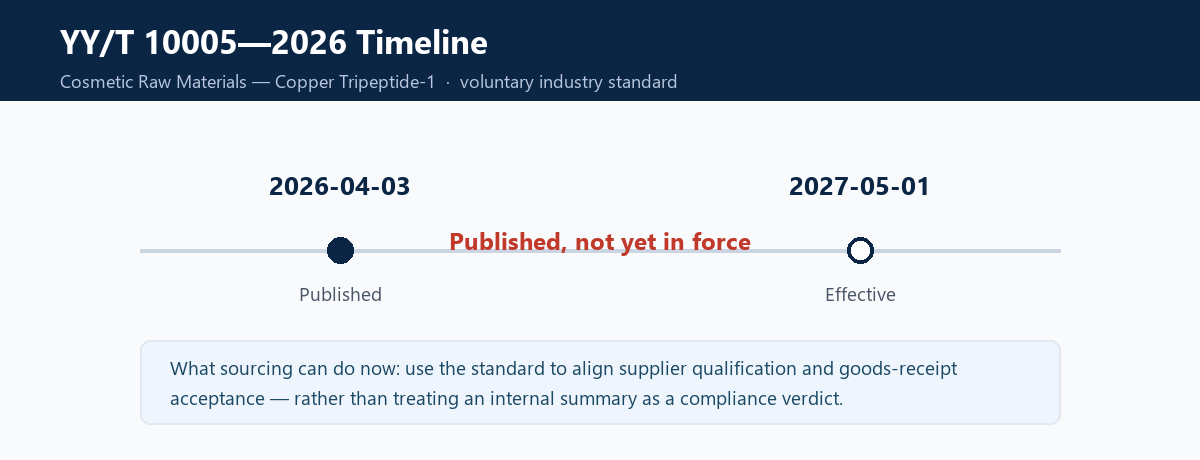
▲ Timeline: published 3 April 2026, effective 1 May 2027
A document that lists only purity, pH, Cu and GHK is therefore one section of the quality picture, not the whole of it.
2. What six anonymized samples show about copper peptide quality
The figures below come from an internal test summary dated 2026-08-11. Samples are labeled S-01 to S-06. Only the cross-sample distribution appears here; nothing on this page evaluates a supplier, brand or batch.
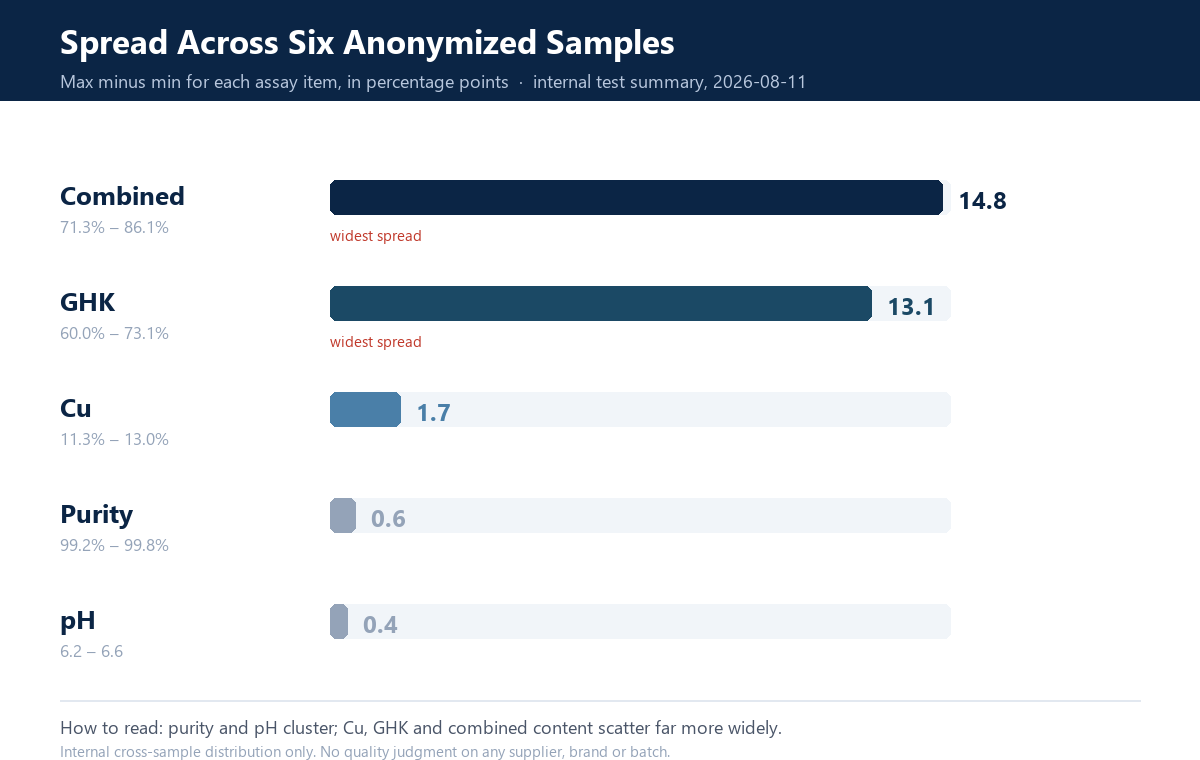
▲ Spread across six anonymized samples: purity and pH cluster, Cu, GHK and combined content do not
| Item | Observed range | Spread | Distribution |
|---|---|---|---|
| Purity | 99.2%–99.8% | 0.6 | |
| pH | 6.2–6.6 | 0.4 | |
| Cu | 11.3%–13.0% | 1.7 | |
| GHK | 60.0%–73.1% | 13.1 | |
| Combined | 71.3%–86.1% | 14.8 |
The headline finding is not that purity sits above 99% across the set. It is that GHK, Cu and combined content scatter far more widely — a 13.1-point range for GHK and 14.8 points for combined content, against 0.6 for purity and 0.4 for pH. Materials that all carry the name "copper peptide" can therefore sit in different, non-interchangeable quality states, which is why a purity-only question tends to leave the composition and measurement-basis questions unasked.
3. Why the standard sets a language, not a single purity cutoff
YY/T 10005—2026 assigns each physical and chemical item its own framework rather than one pass/fail line:
- Purity: not less than 98.0%.
- pH: 5.0–7.5, specified on a 2 mg/mL solution.
- Copper content: not less than 13.0%, on an anhydrous basis.
- Copper tripeptide-1 and tripeptide-1 content: requirements differ by salt form — free (no-salt) type, hydrochloride or acetate.
- Moisture, acetic acid, microbiology and hazardous substances: each carries its own requirement or limit.
Read as a set, these items describe an identity and a basis before they describe a threshold. Two suppliers can both report "high purity" and still be answering different questions.
4. The two phrases that decide whether numbers are comparable
The copper threshold in the standard is written on a dried-material basis. The internal summary referenced here does not include moisture results, the conversion basis, the salt form or the raw methods. Its Cu values (11.3%–13.0%) cannot be mapped onto the standard's requirement, and cannot support a compliance conclusion in either direction.
Copper tripeptide-1 is supplied as a free (no-salt) type, a hydrochloride or an acetate, and the standard sets different content requirements for each. Without the salt form on the label or COA, a content figure has no fixed meaning.
pH follows the same logic. A value inside 5.0–7.5 still says little unless the 2 mg/mL preparation, the electrode and the calibration are documented — falling inside a range is not the same as being tested to the standard.
5. What this dataset cannot answer
None of the following was provided with the summary:
- Salt form, batch number or COA;
- Original chromatograms, reference standards, method conditions, detection limits and method validation;
- Moisture, acetic acid, appearance, odor and specific rotation;
- Total aerobic count, yeast and mold, heat-resistant coliforms, Staphylococcus aureus, Pseudomonas aeruginosa;
- Mercury, lead, arsenic, cadmium, methanol and other hazardous-substance items;
- Packaging integrity, transport and storage conditions.
For every item above, the position taken here is identical: not provided / not tested — no determination. Keeping the known, the unknown and the still-to-be-evidenced in separate places is the part of raw-material communication that prevents later disputes.
6. Five questions to add to a copper peptide supplier checklist
Free (no-salt) type, hydrochloride or acetate? The content requirements are not interchangeable.
Is content calculated on an anhydrous basis, and how is moisture determined? Numbers without a basis cannot be compared.
How are copper tripeptide-1, tripeptide-1, copper and purity tested, and can raw chromatograms be shared?
Microbiological limits and hazardous-substance results, documented rather than assumed from appearance.
Label, COA, retention sample, logistics and storage records that all point back to the same shipment.
FAQ
Is YY/T 10005—2026 mandatory?
No. The National Standards Information Public Service Platform lists it as a voluntary industry standard. It is published with an effective date of 1 May 2027, so it is not yet in force either. Its practical use before that date is as a reference framework for supplier qualification and incoming inspection.
Does a COA showing 99% purity mean the material meets the standard?
Not on its own. Purity is one item among many: the standard also covers identification, copper tripeptide-1 and tripeptide-1 content, copper content on an anhydrous basis, pH on a 2 mg/mL solution, moisture, acetic acid, microbiology and hazardous substances. A purity figure without the salt form, moisture basis and method information cannot be mapped onto the standard.
Why does the salt form change the content requirement?
Because free (no-salt) copper tripeptide-1, the hydrochloride and the acetate have different molecular weights. The same mass of powder therefore contains different amounts of the peptide-copper complex, and the standard sets separate content requirements for each form.
Can the six-sample data be used to judge a supplier?
No. It is an internal cross-sample distribution of five assay items, with no salt form, batch or COA information attached, and no raw method or chromatogram data. It is useful for showing where sample-to-sample variation sits, not for making a quality or compliance determination on any supplier or batch.
About Xiamen PEP-SYN Biotech Co., Ltd
Based in Xiamen, Fujian, China, PEP-SYN specializes in peptide R&D and supply, serving pharmaceutical, research and industrial clients worldwide. All products are intended for research and industrial use only.
📞 Contact: Rocky +86 187 5054 6777
🌐 Website: www.pep-syn.com
📍 Address: 3F, No. 603 Hengtian Road, North Station Business Center, Jimei District, Xiamen, Fujian, China
Disclaimer: This content is for industry communication only and does not constitute medical advice. It is a sourcing and standards note based on public standard information and an internal cross-sample test summary; items not provided in that summary are not judged here, and no brand, supplier or batch is evaluated.