If you assume copper peptide is just another social-media fad, you may miss the signal: its growth is not confined to influencer vanities. It is moving from dermatology clinics and med-spas to the destination where most American consumers shop for health — the pharmacy.
The ingredient in question is Copper Tripeptide-1 (GHK-Cu), a small peptide that forms when the tripeptide GHK — naturally present in human plasma — binds a copper ion. This is a channel-side market note: who is driving demand, what forms the ingredient takes, and which professional gates upstream suppliers must clear.
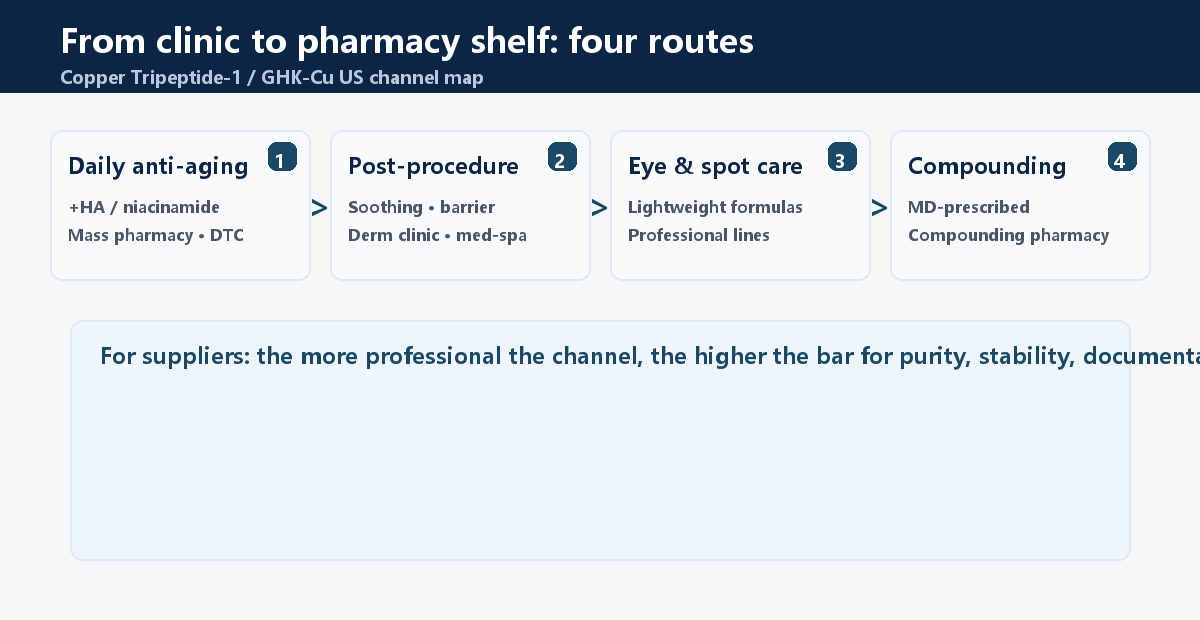
▲ From clinic to pharmacy shelf: a copper-peptide channel map
1. Why the pharmacy — and not the beauty boutique
In the U.S., "the pharmacy" means much more than a prescription window. Chain pharmacies, health-and-beauty retailers and online prescription platforms together form a broad wellness-retail network, and in recent years they have shared one goal: moving professional skincare from "beauty spending" into "health management."
The shelf logic has shifted accordingly: consumers no longer decide on packaging and fragrance alone. They arrive with a dermatologist's recommendation, a name from the ingredient list, sometimes even an abstract of a clinical study. That plays directly to copper peptide's strength — it sounds complex, yet has a clear research trail and an explainable pathway. Add the post-procedure repair demand created by the med-spa boom and consumers' preference for INCI-listed, mechanism-first ingredients, and "professional repair" becomes the pharmacy-shelf story that keeps repeating.
2. Where demand comes from: three groups at once
Collagen loss, fine lines and laxity shift their priority from "brightening first" to "firming and repair together," and they will pay for peptide products with an explainable mechanism.
After laser, microneedling or radiofrequency sessions, skin needs soothing and barrier support; copper peptide's repair narrative fits naturally into post-procedure home care.
After years of over-exfoliation and aggressive actives, more consumers are looking for "gentle but professional" alternatives and no longer equate stinging with effectiveness.
The three groups are not isolated: an anti-aging shopper over 40 may also be doing procedures, and a procedure patient may also have sensitive skin. What they share is a willingness to research ingredients and a higher trust in pharmacy- and physician-delivered information — which gives copper peptide a natural channel dividend for "professional skincare."
3. The forms it takes at the pharmacy and clinic
Combined with hyaluronic acid, niacinamide or ceramides, positioned for everyday firming and hydration.
Emphasizing soothing, barrier support and mild formulation for at-home post-procedure routines.
Lightweight formats aimed at periorbital lines and expression lines.
Prescribed by dermatologists and prepared to order — the most notable route. The U.S. has a mature compounding-pharmacy ecosystem, and copper peptide, an active with repair research behind it, is appearing in more "physician-prescribed, pharmacy-compounded" lists. For upstream raw-material suppliers this means a higher bar — and higher value.
4. Catching this wave means clearing the "professional gate"
U.S. pharmacy channels will not lower their standards because an ingredient is trending. Copper peptide material that can genuinely enter prescription-grade or professional-grade systems has to survive questions in five dimensions:
- Purity and batch consistency: every COA directly affects formulation reproducibility.
- Stability and compatibility logic: whether chelators, strong oxidative systems and mismatched pH are avoided decides if the product keeps activity — and that signature blue — on the shelf.
- Claim boundary: "helping skin maintain its normal repair process" and "treating wounds" are different tracks; cosmetic versus drug claims must be kept apart before entering the U.S. market.
- Documentation and traceability: professional buyers will check raw-material origin, test reports, stability data and compliance files.
- Sustainable formulation support: suppliers who can advise on compatibility and applications become long-term partners.
Note: this article makes no drug-efficacy claims. Uses in cosmetics and skin care must follow local regulations and each product's final claim boundary.
About Xiamen PEP-SYN Biotech Co., Ltd
Based in Xiamen, Fujian, China, PEP-SYN specializes in peptide R&D and supply, serving pharmaceutical, research and industrial clients worldwide. All products are intended for research and industrial use only.
📞 Contact: Rocky +86 187 5054 6777
🌐 Website: www.pep-syn.com
📍 Address: 3F, No. 603 Hengtian Road, North Station Business Center, Jimei District, Xiamen, Fujian, China
Disclaimer: This article is an overseas market-trend observation and ingredient education note for industry reference only. It does not constitute medical advice, product recommendation or any efficacy promise. For ingredient uses and claims, follow the regulations of the target market.