Pal-GHK is the palmitoylated derivative of the natural tripeptide GHK (glycyl-L-histidyl-L-lysine) — known in cosmetic INCI nomenclature as Palmitoyl Tripeptide-1. A single palmitoyl chain may look trivial, but it fundamentally reshapes the peptide's physicochemical character.
One reading rule up front: most functional claims about Pal-GHK are hypotheses. This note keeps confirmed chemistry and unproven signaling roles in separate buckets.
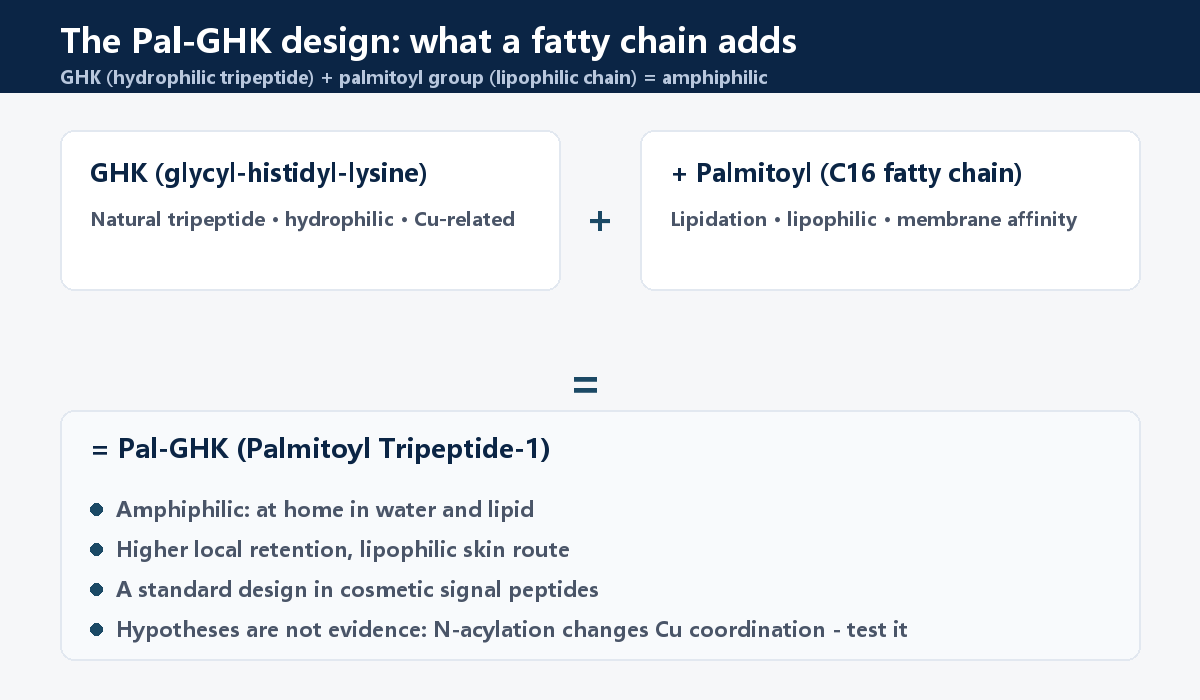
▲ The Pal-GHK design: what lipid modification adds
1. What it is: GHK plus a fatty chain
GHK was first identified in human serum in 1973 (Pickart & Thaler, 1973), and five decades of work have built around its tissue-remodeling and copper-binding biology. Pal-GHK adds a palmitoyl group (a C16 fatty chain) to that backbone, yielding an amphiphilic structure: GHK's water-compatible character plus new affinity for lipid environments.
2. What lipidation actually changes: the evidence-backed part
Fatty-acid modification of short peptides is a well-established tool in both research and cosmetics. Its documented effects center on three points:
- Lipophilicity and membrane affinity: the palmitoyl tail helps the peptide partition into lipid bilayers, micelles and other amphipathic environments, which experimentally tends to mean longer local retention or better skin-absorption potential.
- Transdermal design logic: cosmetic signal peptides are routinely palmitoylated (Pal-GHK, and pal-KTTKS as palmitoyl pentapeptide-4) to improve residence in the stratum corneum — an established route in topical peptides for aged skin (Gorouhi & Maibach, 2009).
- Formulation friendliness: a lipidated peptide sits more comfortably in oil phases and emulsion systems.
3. A detail usually glossed over: N-terminal acylation vs copper coordination
Copper binding is a defining theme of GHK biology: the copper ion coordinates through the histidine imidazole and other sites. The point rarely made is that Pal-GHK's palmitoyl group is attached to the N-terminal amine — and that N-terminal amine is one of the key participants in GHK's copper coordination. The common claim that "Pal-GHK retains GHK's copper-binding ability" is therefore not self-evident: acylation of the N-terminus changes the coordination environment, and the behavior has to be tested experimentally, not extrapolated from GHK literature.
4. Functional hypotheses vs. direct evidence
Discussions of Pal-GHK often reach toward extracellular-matrix organization, transcriptional regulation, resolution of inflammation and redox modulation. Open the cited papers, however, and a pattern appears: they are baseline studies of GHK, copper or topical peptides (1973-2018) — none is a human or systematic study of Pal-GHK itself. On the evidence ladder, Pal-GHK's established identity is a cosmetic signal-peptide ingredient, not yet a well-characterized drug candidate.
5. Positioning and sourcing
In formulas, Pal-GHK (Palmitoyl Tripeptide-1) is positioned as a signal peptide targeting pathways associated with extracellular-matrix synthesis and remodeling, used in anti-aging and repair claims. When sourcing, apply the three standards from our ingredient series: verifiable purity and COA, sequence confirmation, and batch traceability — with use strictly limited to research and industrial scenarios.
About Xiamen PEP-SYN Biotech Co., Ltd
Based in Xiamen, Fujian, China, PEP-SYN specializes in peptide R&D and supply, serving pharmaceutical, research and industrial clients worldwide. All products are intended for research and industrial use only.
📞 Contact: Rocky +86 187 5054 6777
🌐 Website: www.pep-syn.com
📍 Address: 3F, No. 603 Hengtian Road, North Station Business Center, Jimei District, Xiamen, Fujian, China
Disclaimer: This article is an industry research summary and does not constitute medical or dosing advice. Functional statements about Pal-GHK are largely hypothetical; no human clinical evidence specific to this ingredient exists.
Key references: Pickart L, Thaler MM. Nature. 1973;243(5406):85-87; Pickart L. J Biomater Sci Polym Ed. 2008;19(8):969-988; Borkow G, Gabbay J. Curr Med Chem. 2005;12(18):2163-2175; Pickart L, Margolina A. Int J Mol Sci. 2018;19(7):1987; Gorouhi F, Maibach HI. Int J Cosmet Sci. 2009;31(5):327-345.