GHK-Cu (glycyl-L-histidyl-L-lysine copper, Copper Tripeptide-1) is a copper-binding tripeptide found naturally in the human body and has become a growing focus of biomedical research. Scientists are studying its possible roles in cellular communication, tissue repair, collagen production and the body's response to oxidative stress.
One honest caveat up front: most evidence today comes from laboratory and animal studies, and medical uses are still being investigated. This article maps the research themes for formulators and ingredient buyers.
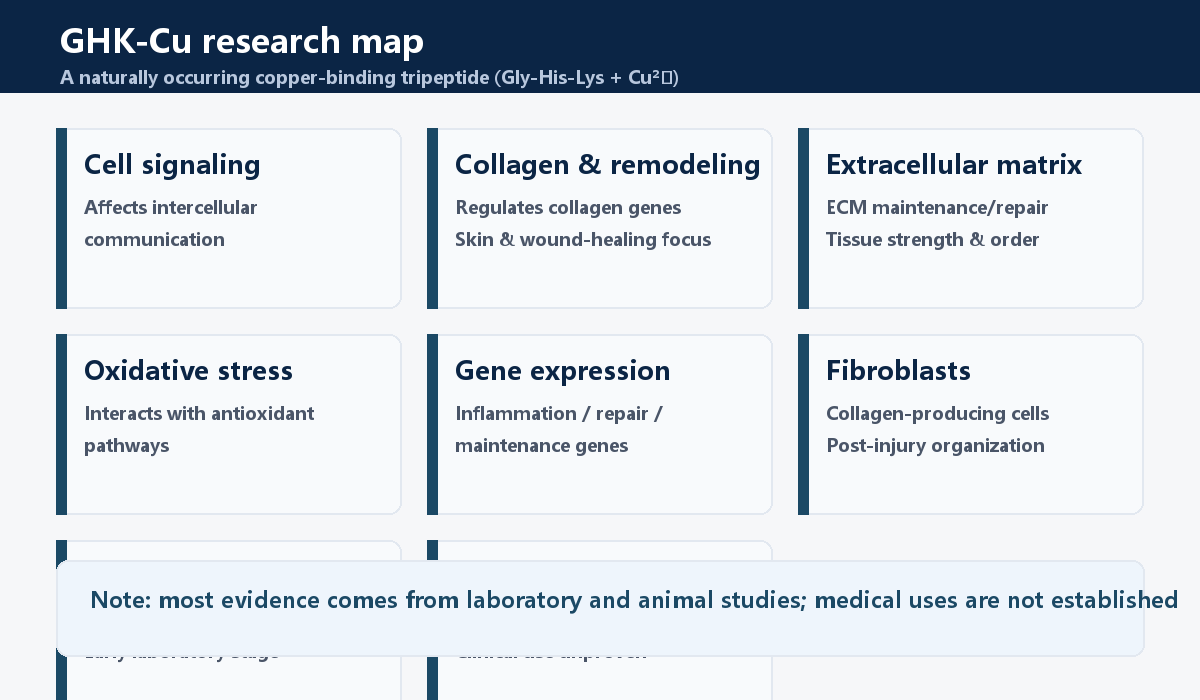
▲ GHK-Cu research map
1. What it is: three amino acids plus a copper ion
GHK-Cu is built from glycine, histidine and lysine. When the three amino acids bind a copper ion (Cu²⁺), the full peptide–copper complex forms. Researchers have found this natural peptide in human blood, saliva and urine, and studies suggest its levels decline gradually with age — a detail that keeps GHK-Cu in the "healthy aging" conversation.
2. Why it is treated as a signaling molecule
Cell signaling is how cells talk to one another, helping the body respond to injury, stress and environmental change. GHK-Cu is not thought to build new tissue directly; it is believed to influence the biological signals that help cells repair and maintain tissue. That distinction is the frame for everything else.
3. Collagen and tissue repair: the earliest-studied path
Collagen is one of the body's most important structural proteins, giving strength to skin, bone, tendon and connective tissue. Laboratory research suggests GHK-Cu may help regulate genes involved in collagen production and tissue remodeling. In a classic rat wound model the tripeptide–copper complex stimulated connective-tissue accumulation in vivo (Maquart et al., 1993), which is why GHK-Cu remains a fixture in skin and wound-healing research (Pickart, 2008).
4. Extracellular matrix and oxidative stress
The extracellular matrix (ECM) is the protein-and-molecule network that surrounds and supports cells; a healthy ECM keeps tissue strong, flexible and organized. Early research suggests GHK-Cu may influence how this network is maintained and repaired. Separately, oxidative stress occurs when free radicals accumulate faster than the body can neutralize them — and researchers are asking whether GHK-Cu interacts with antioxidant pathways that protect the cellular environment.
5. Gene expression and fibroblasts
Modern studies link GHK-Cu to gene expression: scientists report the peptide may influence genes involved in inflammation, tissue repair, antioxidant activity and cellular maintenance (Pickart & Margolina, 2018), making it an object of growing interest in regenerative biology. Fibroblasts are the cells that produce collagen and maintain connective tissue; understanding GHK-Cu's interaction with them may explain how tissue organizes and repairs itself after injury.
6. Brain research: early stage only
Because copper is essential for normal brain function, researchers are testing under laboratory conditions whether copper-binding peptides such as GHK-Cu could influence neuronal signaling and help protect nerve cells. This line of work remains at an early stage.
7. The evidence boundary: promising in the lab, unproven in the clinic
The scientific consensus is deliberately restrained: most evidence comes from laboratory and animal studies, not large human clinical trials. Safety, efficacy and potential medical applications all await further clinical research. Copper metabolism itself also has a balance problem — one review warns that humans may need to watch copper and iron overload during aging (Brewer, 2010). For formulators and supplement developers the takeaway is clear: copper peptides earn their value from appropriate, controlled use, not from piling on dose.
8. Ingredient view: quality and compliance still come first
In the industry GHK-Cu is positioned as a research/cosmetic ingredient. When sourcing, the three standards from our ingredient series apply: verifiable purity and COA, stable copper complexation, and full batch traceability — with uses strictly limited to research and industrial scenarios.
About Xiamen PEP-SYN Biotech Co., Ltd
Based in Xiamen, Fujian, China, PEP-SYN specializes in peptide R&D and supply, serving pharmaceutical, research and industrial clients worldwide. All products are intended for research and industrial use only.
📞 Contact: Rocky +86 187 5054 6777
🌐 Website: www.pep-syn.com
📍 Address: 3F, No. 603 Hengtian Road, North Station Business Center, Jimei District, Xiamen, Fujian, China
Disclaimer: This article is an industry research summary and does not constitute medical or dosing advice. Medical uses of GHK-Cu are not approved; efficacy statements are drawn from laboratory and animal studies.
Key references: Maquart FX, et al. J Clin Invest. 1993;92(5):2368-2376; Pickart L. J Biomater Sci Polym Ed. 2008;19(8):969-988; Pickart L, Margolina A. Int J Mol Sci. 2018;19(7):1987; Canapp SO, et al. Vet Surg. 2003;32(6):515-523; Brewer GJ. Chem Res Toxicol. 2010;23(2):319-326.