In early September 2026, Chad Wolf — former Acting U.S. Secretary of Homeland Security — published an opinion piece on Fox News warning that an unapproved weight-loss drug pipeline is moving from Chinese chemical manufacturers into American homes. The article names retatrutide ("reta"), an obesity/type 2 diabetes candidate still in clinical trials, and cites blockchain-forensics findings on where the money flows.
This article takes no political position. We read the reporting as a compliance signal for the peptide industry: enforcement and traceability are tightening on multiple fronts, and the boundary for legitimate export of peptide materials is getting clearer. Allegations against named parties are quoted from public reporting and have not been independently verified.
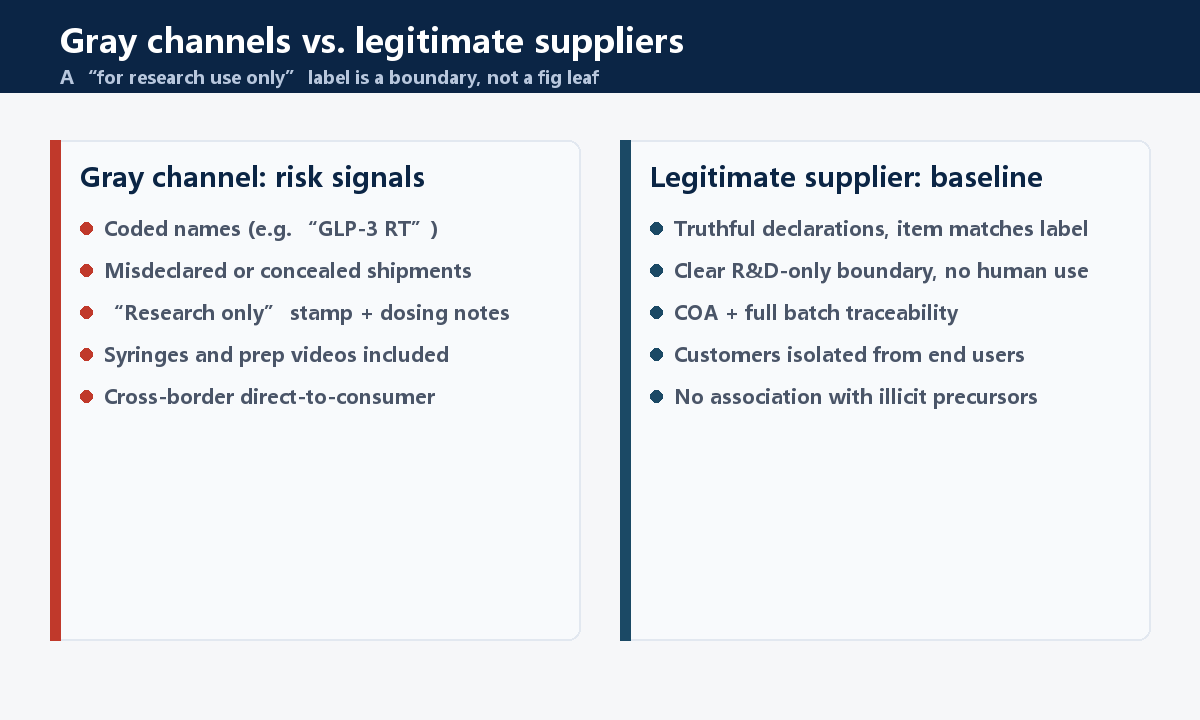
▲ Gray-channel risk signals vs. legitimate-supplier baselines
1. What the reporting says
Per the Fox News column: retatrutide is in clinical trials; there is no FDA-approved version, no lawful generic, and selling it to patients is illegal. The column alleges it is entering U.S. homes through customs fraud, concealed shipments and relabeling by American middlemen.
The column cites two blockchain-intelligence firms. Chainalysis says it traced proceeds from U.S. peptide sales flowing back to China-based chemical manufacturers linked to synthetic opioids such as fentanyl. TRM Labs says it detected fentanyl-precursor producers moving into the "peptide business." On enforcement, the column reports a CBP operation in Cincinnati that uncovered more than 300 master cartons from China holding roughly 5,000 peptide shipments, retatrutide among them.
It also describes gray-market tactics: vendors use coded names (such as "GLP-3 RT" for retatrutide), misdeclare parcels, and — critically — stamp packages "for research use only" while including weekly dosing instructions, syringes and videos showing how to prepare the drug for injection.
Allegations in an opinion column — especially links to named firms and individuals — are not court findings. What matters for the industry is the trend itself: customs enforcement, on-chain traceability and platform risk controls are converging, and they increasingly reach past intermediaries to the ultimate payees and shippers.
2. Three takeaways for legitimate suppliers
First, "for research use only" is a legal boundary, not a disclaimer. In a compliant operation it means: no human consumption, no dosing or administration guidance, no syringes alongside the vial. When a research-only stamp travels in the same parcel as dosing instructions and prep videos, enforcement and courts read that as evidence of deliberate evasion — not compliance.
Second, gray channels erode trust for the whole industry. Regulators, blockchain forensics and logistics data are being cross-referenced: payment accounts, shipping addresses and platform records all get traced. A few bad actors can push regulators to treat peptide exports as a high-risk category, raising compliance and customs cost for everyone legitimate.
Third, the moat of a legitimate supplier is full-chain explainability. Gray sellers hide behind codes and misdeclaration; compliant manufacturers can account for every batch — purity and COA, destination, declared description, use boundary. That transparency is the clearest possible separation from the gray market.
3. Five compliance baselines for buyers and suppliers
- Truthful declaration: description, quantity and contents match reality; no relabeling or concealment.
- Clear use boundary: materials go to research and industrial customers only — never direct-to-consumer, never with human dosing guidance.
- Traceable documentation: COA and regulatory-status statements travel with the lot, with batch traceability and end-use review.
- Avoid the "three red flags": coded names, vague product descriptions, or "research only" plus administration instructions — any one of these should trigger a refusal.
- Documented channels: work only with suppliers that sign sales terms and use statements, and keep complete records.
For brands and R&D teams the rule is the same at the other end: buy approved GLP-1 medicines through authorized channels. A clinical-stage candidate without approval — retatrutide included — has no "lawful stock" at any price. The real cost of a cheap deal is regulatory risk and quality you cannot trace.
About Xiamen PEP-SYN Biotech Co., Ltd
Based in Xiamen, Fujian, China, PEP-SYN specializes in peptide R&D and supply, serving pharmaceutical, research and industrial clients worldwide. All products are intended for research and industrial use only and are not sold to individual consumers.
📞 Contact: Rocky +86 187 5054 6777
🌐 Website: www.pep-syn.com
📍 Address: 3F, No. 603 Hengtian Road, North Station Business Center, Jimei District, Xiamen, Fujian, China
Disclaimer: This article is an industry-compliance information note, not legal advice. Allegations concerning specific enforcement cases, companies and individuals are quoted from the opinion column by Chad Wolf (Fox News, September 2, 2026) and related public reporting; they have not been independently verified, and the facts are as published by judicial and enforcement authorities.
Sources: Fox News Opinion (Chad Wolf, Sept. 2, 2026); public reporting citing Chainalysis and TRM Labs.