Say you are asked to build a brightening serum. On the bench sit arbutin, niacinamide, tranexamic acid and a vitamin C derivative. Which goes in the water phase, which turns under light, which only performs at low pH? Every question points back to one habit: pick the ingredient by the effect you want, then place it by its chemistry. This guide walks through five families — whitening, exfoliating acids, hydration and repair, UV filters, and peptides — and closes with a sourcing checklist.
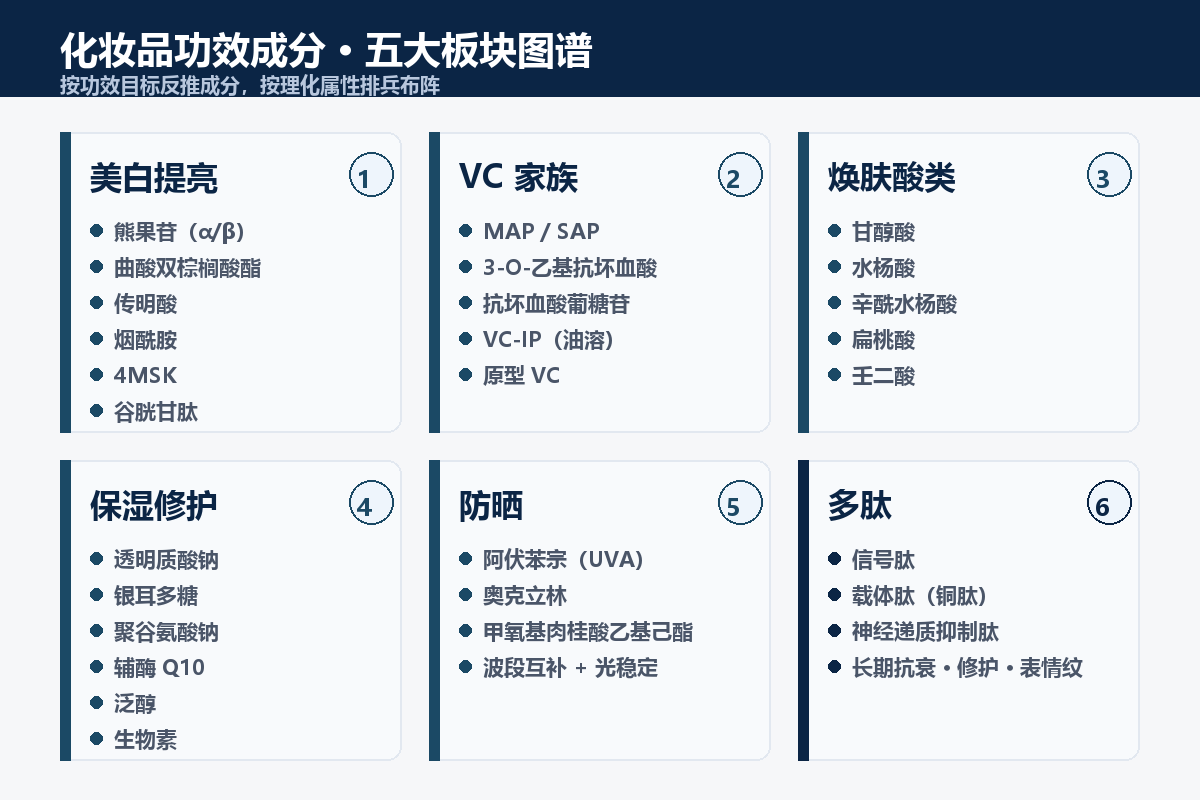
▲ Five families of cosmetic active ingredients
1. Whitening and brightening: position matters
Whitening actives all "brighten," but they work at different stations in the pigment pipeline: some inhibit tyrosinase, some block melanin transfer, some reduce. Where they act decides how you place them.
Arbutin comes in alpha and beta forms. Alpha-arbutin is the epimer of beta-arbutin; the industry generally treats the alpha form as the stronger inhibitor and the beta form as the cost-friendly workhorse. Both are water-soluble and dislike prolonged heat.
Kojic acid is a strong tyrosinase inhibitor with a known weakness: light and metal ions knock it down. Kojic dipalmitate tacks two palmitate chains onto it, turning it oil-soluble and sturdier for the oil phase. Tranexamic acid (CAS 1197-18-8) calms inflammatory signals so the skin gets less of the "make more pigment" nudge; it is stable, water-soluble and widely compatible. 4MSK (potassium methoxysalicylate) brings mild exfoliation alongside even tone. Niacinamide (CAS 98-92-0) skips enzyme inhibition entirely — it slows melanin transfer into the epidermis and chips in barrier repair and oil control. Reduced glutathione handles reduction and antioxidation; the catch is that it oxidizes easily. Potassium azeloyl diglycinate is a water-soluble, gentler precursor of azelaic acid.
2. The vitamin C family: stability versus activity
Ascorbic acid itself is potent and a proven antioxidant, but it fears water, light and heat, demanding a low-pH, low-oxygen home. That demand is exactly why the derivatives exist. MAP and SAP are both water-soluble and stable; 3-O-ethyl ascorbic acid is small and amphiphilic; ascorbyl glucoside (AA2G) releases vitamin C enzymatically; VC-IP is oil-soluble and very stable, built for the oil phase of anti-aging creams.
The shorthand: water serums take water-soluble derivatives, oils and creams take VC-IP, and 3-O-ethyl ascorbic acid balances penetration against stability.
3. Exfoliating acids: three rulers, one decision
Judge an acid on three things: water- or oil-solubility, molecular size, and irritation potential. Glycolic acid (CAS 79-14-1) is the smallest AHA — fast-penetrating, strong, with irritation to match. Salicylic acid (CAS 69-72-7) is an oil-soluble BHA that works inside the pore; for sensitive skins, betaine salicylate offers a water-phase, slow-release version. Capryloyl salicylic acid is more lipophilic, larger and gentler. Mandelic acid (CAS 90-64-2) is a large AHA, low in irritation. Azelaic acid (CAS 123-99-9) handles acne, inflammation and uneven tone, but it is poorly water-soluble and prone to crystallizing.
4. Hydration, repair and soothing: give every ingredient a job
Do not read this section as "hydration." Split the work: moisturize, antioxidation, soothe, repair. Sodium hyaluronate is the base humectant; tremella polysaccharide film-forms with a light feel; sodium polyglutamate holds water strongly. On the antioxidant bench: coenzyme Q10 guards against lipid peroxidation; resveratrol adds antioxidant and anti-inflammatory coverage; ferulic acid routinely joins vitamins C and E to stabilize the trio; phloretin assists penetration. On the soothe-and-repair bench: panthenol (provitamin B5) repairs the barrier and moisturizes gently; biotin feeds keratin metabolism.
5. UV filters: build the team by wavelength
Filters split by band: UVB (290–320 nm) drives sunburn, UVA (320–400 nm) drives tanning and photoaging. Benzophenone-3 covers a wide slice but carries photostability and safety debate. Avobenzone is the workhorse UVA filter whose weakness is photo-instability; it needs a stabilizer partner. Octocrylene holds the UVB line and doubles as avobenzone's stabilizer. Ethylhexyl methoxycinnamate is the classic cost-friendly UVB filter. The rule: never send avobenzone out alone — pair it with a stabilizer and re-verify SPF and photostability as a system.
6. Peptides: three logics, three classes
Peptides are the fastest-rising corner of active ingredients — and a core focus on the raw-material supply side. Sort a peptide by what it does: sending a signal, delivering a metal, or quieting expression lines.
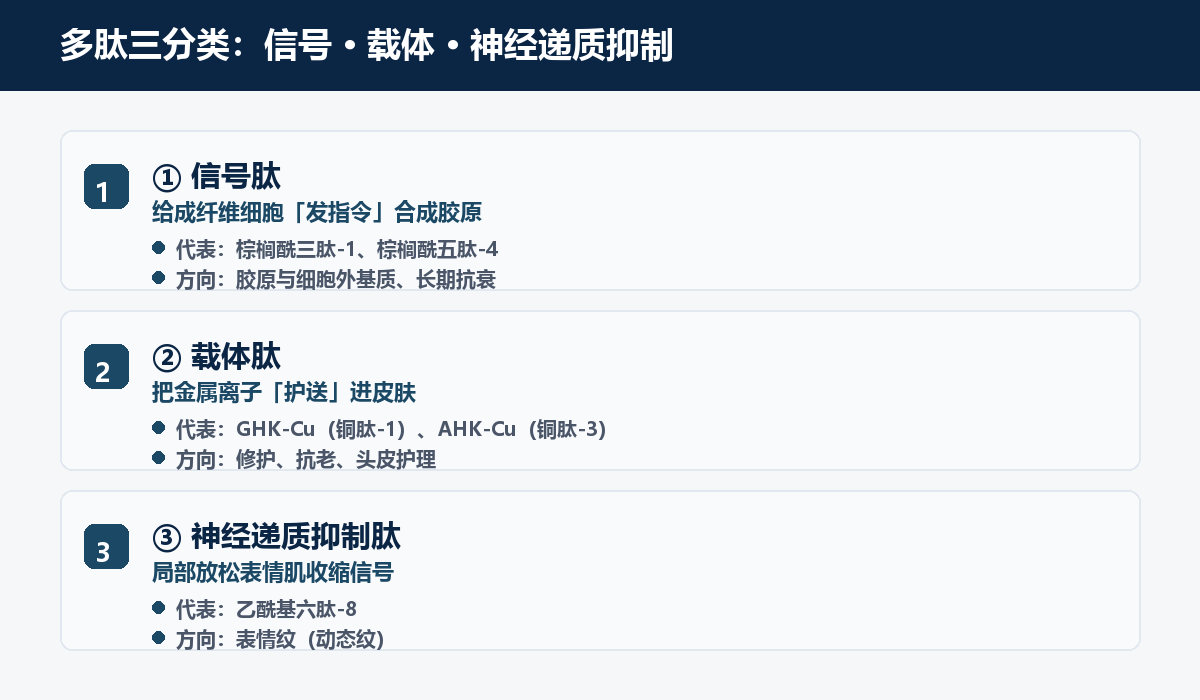
▲ Peptide classes: signal / carrier / neurotransmitter-inhibiting
Instruct fibroblasts to build collagen. The standard examples are palmitoyl tripeptide-1 and palmitoyl pentapeptide-4, aimed at collagen and the extracellular matrix. Note: signal peptides work slowly — position them for long-term anti-aging.
Shuttle metal ions into the skin. GHK-Cu (Copper Tripeptide-1) is the first copper-binding tripeptide, reported by Pickart in 1973, driving repair and collagen via copper; AHK-Cu (Copper Tripeptide-3) also delivers copper, leaning toward repair and hair-growth applications. Note: copper is reactive — check compatibility with strong chelators such as EDTA and with strong acids.
Soften expression lines. Acetyl hexapeptide-8 is the flagship, easing muscle contraction by tempering neurotransmitter release, aimed at dynamic wrinkles. Note: this class fits lines carved by repeated expression; deep static wrinkles need a different plan.
7. The five-point sourcing checklist
Before you look at price, run a new ingredient through five gates:
- Stability: does it survive temperature, pH and light? Ask for the stability report.
- Solubility: water or oil phase — and how do addition order and temperature change?
- Compatibility: does it clash with chelators, pH extremes, or metal ions?
- Claim support: efficacy data and literature — in vitro or human — and whether the source holds up.
- Supplier support: COA, stability data, regulatory status and technical backing.
Peptide demand keeps climbing, and the question buyers ask most is purity and batch-to-batch consistency. When choosing a supplier, complete documentation and dependable long-term supply beat price.
FAQ
Layer by action site: one tyrosinase inhibitor (arbutin, kojic acid derivatives) plus one transfer blocker (niacinamide) plus one reducing/antioxidant active (glutathione, vitamin C derivatives) — rather than stacking several actives from the same layer. Also watch the oxidation stability, pH window and light sensitivity of the vitamin C family and reducing agents.
Verify compatibility in advance. Copper ions in copper peptides may be affected by strong chelators (such as EDTA) and strong acids, which can impact complexation and activity. Run compatibility and stability pre-tests before finalizing a formula.
Check four things: sequence and purity confirmed by COA; for copper peptides, the metal complexation state; batch-to-batch stability data; and whether the supplier offers storage guidance and formulation support. Stability data across batches say more than a single purity number.
Purity and impurity profile, synthesis route, stability data, regulatory status and supply-chain reliability all show up in price. The hidden cost of low-priced material usually lands on batch consistency and supporting documentation, so compare COAs and technical support rather than unit price alone.
Further reading
· Short Peptides for Hair Loss: Mechanisms and Evidence
· AHK-Cu (Copper Tripeptide-3): Chemistry and Formulation Notes
About Xiamen PEP-SYN Biotech Co., Ltd
Based in Xiamen, Fujian, China, PEP-SYN specializes in peptide R&D and supply, serving pharmaceutical, research and industrial clients worldwide with high-quality peptide ingredients and technical support.
📞 Contact: Rocky +86 187 5054 6777
🌐 Website: www.pep-syn.com
📍 Address: 3F, No. 603 Hengtian Road, North Station Business Center, Jimei District, Xiamen, Fujian, China
Disclaimer: This content is for industry communication only and does not constitute medical advice.