Hair loss is not one disease but a family of skin conditions with different causes. While minoxidil, finasteride, transplantation and physical therapies each carry limitations, short peptides — a class of biocompatible actives that mimic intracellular signals — are being re-evaluated.
This article distills the mechanisms, evidence and practical considerations for sourcing hair-growth peptides, drawing on the 2026 review "Overview of Short Peptides for Hair Loss" published in Biomedicines.
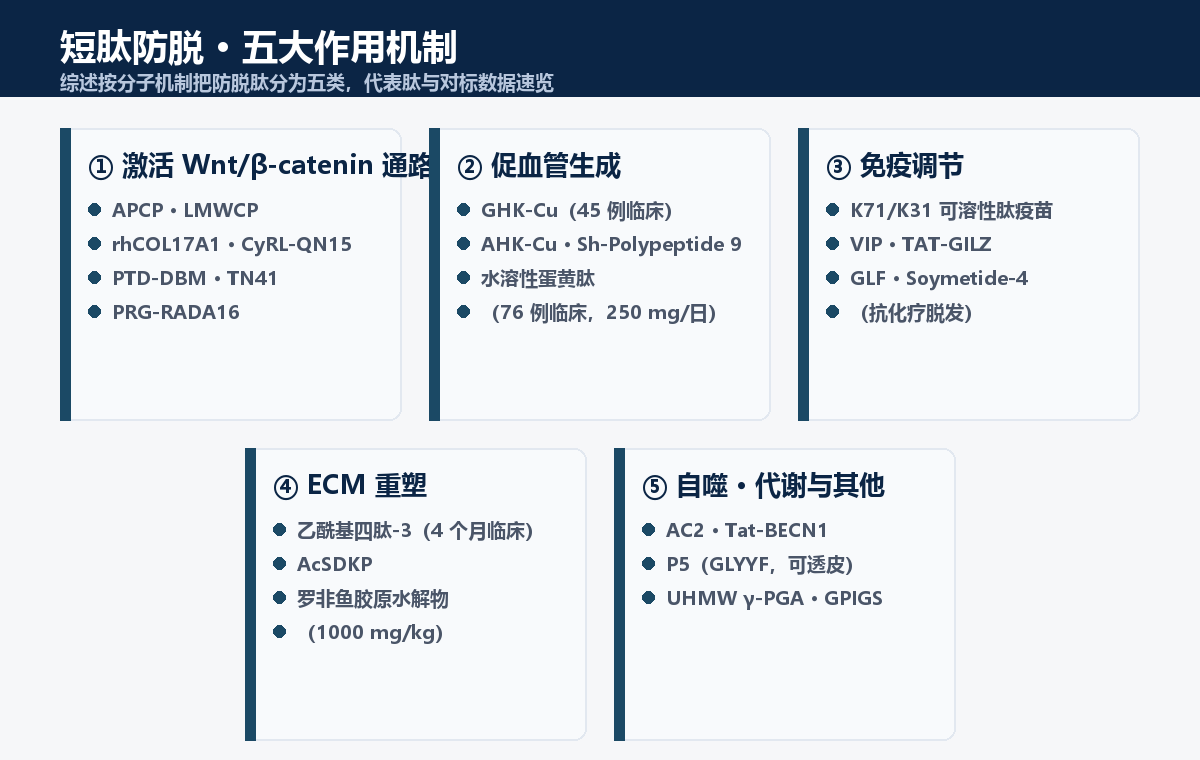
▲ Five mechanisms of short peptides for hair loss
1. Four causes of hair loss and the limits of current options
By etiology, hair loss falls into four groups: androgenetic alopecia (AGA), autoimmune alopecia areata (AA), infectious alopecia such as tinea capitis, and stress-induced telogen effluvium (TE). These four causes follow different biological paths, yet they have long shared the same narrow toolbox.
· On a healthy scalp, about 84% of hairs are in anagen and about 15% in telogen — treating hair loss, at bottom, means nudging that ratio back.
· A large South Asian survey puts AGA prevalence at roughly 14.1% in men and 5.6% in women.
Each conventional option has a boundary. Topical minoxidil reaches roughly a 60% one-year response rate, depends on follicular sulfotransferase activity, and varies between individuals; stopping usually brings shedding back within 12–24 weeks. Oral finasteride and dutasteride lower dihydrotestosterone (DHT) by inhibiting 5α-reductase, but sexual and mood side effects weigh on adherence, and some studies point to a possible increase in high-grade prostate cancer risk. Hair transplantation is capped by donor supply and graft survival, while microneedling and low-level laser therapy (LLLT) hinge on parameters and individual response. These gaps are where short peptides enter the picture.
2. Five mechanisms of short peptides for hair loss
The review groups hair-loss peptides into five mechanistic classes. For each, the source, sequence or feature, and the reported effect are summarized.
AP collagen peptide (APCP, roughly 3–5 kDa, rich in Gly-Pro-Hyp) from golden threadfin bream skin, dosed orally at 900 mg/kg, approaches 1 mg/kg minoxidil. Recombinant type XVII collagen (rhCOL17A1) performs best at 0.5% w/v. The frog-skin peptide CyRL-QN15 binds the Frizzled-7 receptor directly. Others in this lane include TN41 (an AIMP1 fragment, 100 nM rivaling 3% minoxidil), PTD-DBM (which breaks the CXXC5-Dvl negative regulation), and the self-assembling peptide PRG-RADA16.
A metabolically active anagen follicle needs blood supply. GHK-Cu (first reported by Pickart in 1973) promoted hair growth in a clinical study of 45 AGA patients; AHK-Cu drives DPC proliferation and ex vivo follicle elongation; Sh-Polypeptide 9 mimics VEGF; and water-soluble chicken egg yolk peptide, at 250 mg/day, produced significantly higher hair density than placebo over 24 weeks in a 76-subject study.
This cluster targets alopecia areata and chemotherapy-induced shedding. Soluble K71/K31 peptide vaccines make T cells unresponsive to peptide antigens. Vasoactive intestinal peptide (VIP) preserves follicle immune privilege at 10⁻⁹ M. TAT-GILZ yielded larger, more mature follicles than 5% finasteride or minoxidil in mice. GLF and the soy-derived Soymetide-4 (MITL) countered etoposide-induced alopecia in neonatal rats.
The extracellular matrix (ECM) gives the follicle structural support and biochemical signals. Acetyl tetrapeptide-3 (Ac-KGHK, the active in Capixyl) significantly raised the anagen/telogen ratio in a four-month clinical study. The natural tetrapeptide AcSDKP promotes keratinocyte stem cell and DPC proliferation. Tilapia collagen hydrolysate at 1000 mg/kg outperformed 1 mg/kg finasteride in a mouse model.
AC2 (from Trapa japonica fruit) activates mTORC1, with 10 mg/mL reversing the proliferative damage of 1 mg/mL DHT. Tat-BECN1 delays AA onset by inducing autophagy. The pentapeptide P5 (GLYYF) activates AdipoR1/AMPK, crosses skin, and at 0.1 mM approaches 3% minoxidil. Ultra-high molecular weight γ-PGA inhibits 5α-reductase, and GPIGS improved hair diameter in a clinical study of 22 Japanese men with AGA.
Unlike the relatively narrow paths of minoxidil and finasteride, many peptides touch several pathways at once — a "multi-target" intervention, which is exactly why the industry is paying attention. Whether the pathways truly synergize still lacks direct experimental proof.
3. Four hurdles between the bench and the shelf
First, stability: short peptides are built from natural L-amino acids and degrade readily through enzymatic digestion and hydrolysis. Second, permeability: most peptides cross membranes poorly, so studies often fall back on injection or oral dosing. Third, immunogenicity: T cells are built to recognize peptide antigens, and both FDA and EMA set strict assessment guidelines. Fourth, evidence level: clinical cohorts are small and rarely compared head-to-head against minoxidil or finasteride, and assessment metrics remain unstandardized.
4. Nanodelivery and combination strategies
Delivery is the main battleground for short peptides. Research shows 200 nm particles reach the follicle isthmus, while 20–40 nm particles reach the bulb. A 40 nm nanoliposome co-loading copper peptide, acetyl tetrapeptide-3 and myristoyl pentapeptide-4 achieves higher penetration and cellular uptake than free peptides; microneedles are also used to boost delivery of water-soluble peptides.
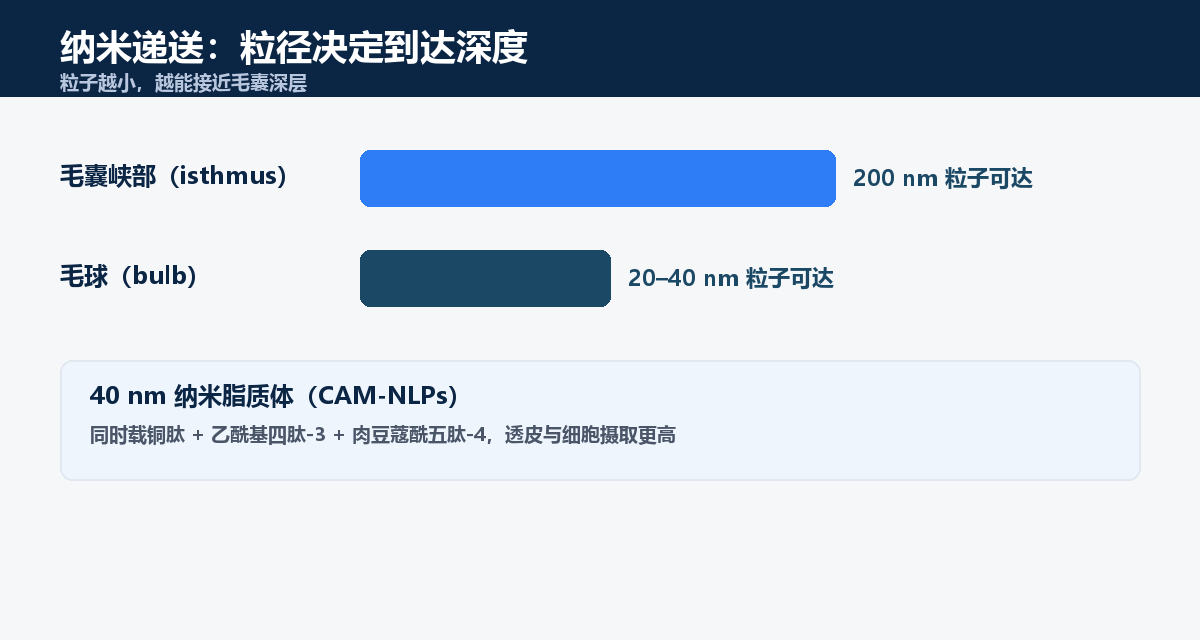
▲ Nanodelivery: particle size decides how deep it goes
Combinations are being validated too. QR678 Neo (Sh-polypeptides plus copper tripeptide) raised mean hair count by 5.64 in 20 women with TE. BRS, a serum containing biotinoyl tripeptide-1, lifted hair density by 107.2%. On the target side, KCNJ2, GPR30, THSD4 and the LH/TRPC axis are all in discussion as routes to more selective peptides.
5. New targets on the horizon
Beyond direct Wnt activation, the review highlights several new targets for more selective peptides: KCNJ2 (a potassium channel that enhances fibroblast Wnt signaling), GPR30 (a membrane-associated estrogen receptor), THSD4 (an ECM protein at the DP–hair matrix interface acting through the SDC4-THSD4-CXCL1 axis), and the LH/LHR/TRPC axis (relevant to female-pattern hair loss). These open routes to peptides with narrower, more specific action.
6. What to check when sourcing a hair peptide
From a raw-material standpoint, four dimensions deserve attention. Sequence and purity: the sequence defines activity, while purity shapes batch consistency and safety. Stability: can it tolerate formulation pH, temperature and shelf life. Delivery fit: topical, microneedle or nanocarrier determines whether the peptide reaches the follicle at all. Evidence tier: in vitro, ex vivo and clinical data differ sharply in strength — know which tier the claim sits on before you buy.
FAQ
Conventional drugs lean on vasodilation or androgen inhibition, with a relatively narrow path of action. Peptides can touch Wnt, VEGF, immune and ECM pathways at once — a broader biological intervention. Their clinical evidence, however, is still thinner overall, mostly at in vitro, ex vivo or early-clinical stages.
Both are copper-binding tripeptides. GHK-Cu (Copper Tripeptide-1) has the sequence Gly-His-Lys, first reported in 1973, and is linked to VEGF and ECM turnover. AHK-Cu (Copper Tripeptide-3) has the sequence Ala-His-Lys and was shown in 2007 to elongate human hair follicles ex vivo.
Most peptides cross membranes poorly, oral dosing risks off-target effects, and injection hurts compliance — so topical is the current mainstay. Particle size matters: 200 nm particles reach the isthmus and 20–40 nm particles reach the bulb; nanoliposomes and microneedles are common ways to lift delivery efficiency.
Some peptides carry clinical data: GHK-Cu (45 patients), water-soluble egg yolk peptide (76 subjects), acetyl tetrapeptide-3 (four months) and GPIGS (22 men). Sample sizes are small and mostly lack comparison against standard drugs. On safety, short peptides are generally biocompatible, but immunogenicity must be assessed per FDA/EMA guidance.
References
· Fan C, et al. Overview of Short Peptides for Hair Loss. Biomedicines 2026, 14, 864. doi:10.3390/biomedicines14040864 (CC BY 4.0)
Further reading
· AHK-Cu (Copper Tripeptide-3): Chemistry and Formulation Notes
· Cosmetic Active Ingredients Guide: Whitening, Acids & Peptides
About Xiamen PEP-SYN Biotech Co., Ltd
Based in Xiamen, Fujian, China, PEP-SYN specializes in peptide R&D and supply, serving pharmaceutical, research and industrial clients worldwide with high-quality peptide ingredients and technical support.
📞 Contact: Rocky +86 187 5054 6777
🌐 Website: www.pep-syn.com
📍 Address: 3F, No. 603 Hengtian Road, North Station Business Center, Jimei District, Xiamen, Fujian, China
Disclaimer: This content is for industry communication only and does not constitute medical advice.