AHK-Cu (Copper Tripeptide-3, CAS 767286-83-9) is one of the earliest-studied members of the copper-peptide family, with ex vivo hair-follicle data going back to 2007. This article gathers its chemical profile, the Pyo 2007 study data, dermal and collagen in vitro results, and the storage and QC points formulators actually need.
1. One methyl group apart: AHK-Cu vs GHK-Cu
GHK-Cu (glycyl-L-histidyl-L-lysine copper, Copper Tripeptide-1) is the first copper-binding tripeptide, identified by Pickart in 1973. AHK-Cu (alanyl-histidyl-lysine copper, Copper Tripeptide-3) replaces the first glycine with alanine, adding a single methyl group to the molecule.
That small change alters solubility, complexation and compatibility. For formulators, AHK-Cu cannot be treated as a drop-in replacement for GHK-Cu: buffer systems, pH and interactions with other copper-sensitive actives all need re-checking. The 2007 Pyo et al. ex vivo hair-follicle study gave AHK-Cu its first systematic dataset.
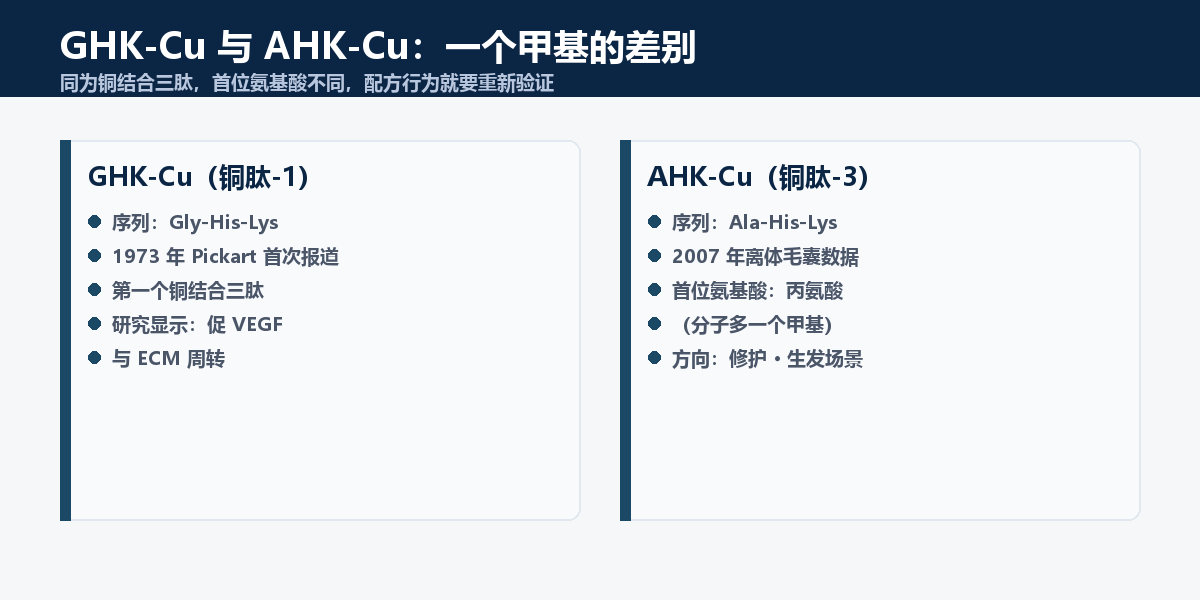
▲ GHK-Cu vs AHK-Cu: one methyl group apart
2. AHK-Cu chemical profile
| Item | Value |
|---|---|
| Product name | Copper tripeptide-3 (AHK-Cu) |
| CAS number | 767286-83-9 |
| Molecular formula | C15H24CuN6O4 |
| Molecular weight | 415.93 |
| Exact mass | 414.10767 |
| Appearance | Light blue to blue solid powder |
| Alias | Copper tripeptide-3 |
| HS Tariff Code | 2934.99.9001 |
| InChI Key | NTHUFERRBBBKHC-LBRAPMIBSA-L |
The blue color of copper peptides comes from the copper complexation state. Light blue to blue appearance is itself a quick QC signal; color drift can point to complexation or purity issues.
3. Study data: Pyo 2007 ex vivo hair follicles
AHK-Cu's core evidence comes from Pyo et al., published in Arch Pharm Res. 2007;30(7):834-839. The team cultured 240 ex vivo human hair follicles from three volunteers for 12 days and observed elongation promoted across 10⁻¹³ to 10⁻⁷ M.
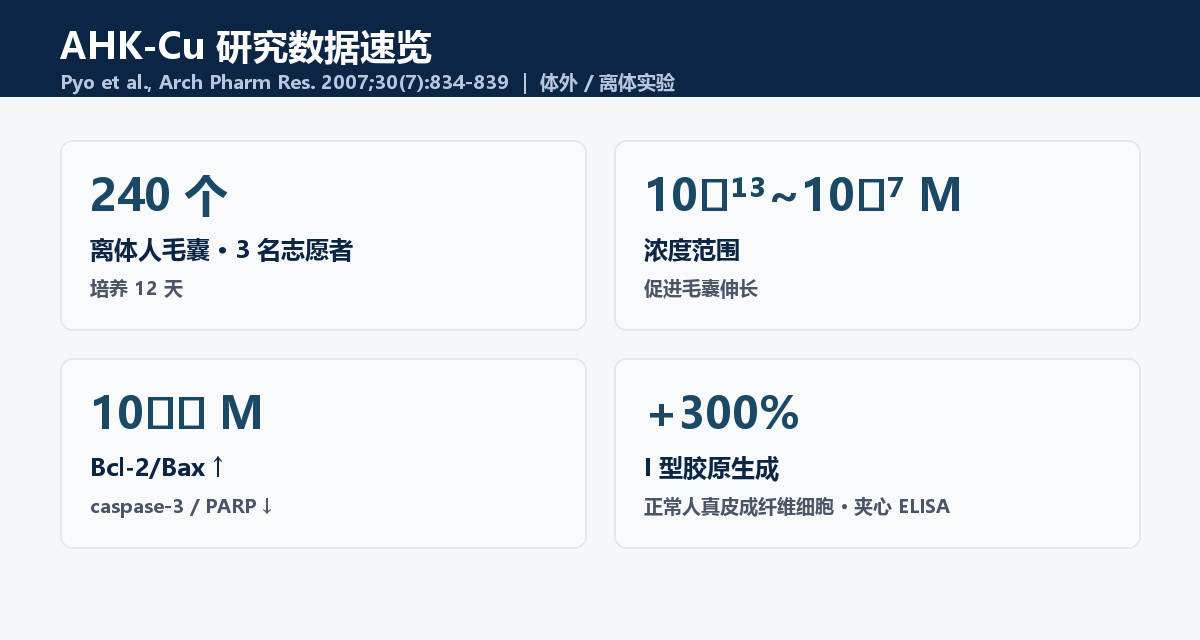
▲ AHK-Cu study data at a glance (Pyo et al., 2007)
In the same system, an MTT assay showed AHK-Cu stimulated dermal papilla cell (DPC) proliferation. The apoptosis side is more specific: at 10⁻⁹ M, the Bcl-2/Bax ratio rose and cleaved caspase-3 and PARP levels fell. The authors concluded AHK-Cu supports hair-follicle growth by promoting DPC proliferation and inhibiting DPC apoptosis.
A 2026 review (Biomedicines 14:864) carries this conclusion into its mechanism table for peptide-based hair loss, cementing AHK-Cu as an established copper peptide in ex vivo research. These are in vitro and ex vivo results, not human clinical conclusions.
4. Dermal and collagen data: the anti-aging angle
Beyond the scalp, AHK-Cu has dermal data. Cultures of normal human dermal fibroblasts showed AHK-Cu promoted proliferation and viability; sandwich ELISA measured type I collagen production up 300% versus control after treatment.
This in vitro evidence underpins AHK-Cu's anti-aging and periorbital applications and explains its presence in formulas making collagen-regeneration claims. As a peptide supplier, we suggest brands anchor claims in the data itself, using "in vitro studies indicate" wording and staying within cosmetic boundaries.
5. Formulation use, storage and quality
In practice, AHK-Cu appears in scalp-care and hair-loss formulas, often combined with GHK-Cu or biotinoyl tripeptide-1; in anti-aging and eye products it backs collagen and dermal-repair claims. AHK-Cu is a research/cosmetic ingredient, and this article makes no medical claims.
· Powder: -20°C for 3 years; 4°C for 2 years
· In solution: -80°C for 6 months; -20°C for 1 month
· Room-temperature shipping is stable for a few days in transit and customs
Incoming QC should check four points: appearance (light blue to blue), HPLC purity, copper content and complexation state, and batch-to-batch stability. The complexation state directly affects batch consistency, so review the COA for every lot.
FAQ
Both are copper-binding tripeptides; the difference is the first amino acid. GHK-Cu has glycine, AHK-Cu has alanine (one extra methyl group). GHK-Cu's research history starts in 1973, while AHK-Cu's systematic data begins with Pyo's 2007 ex vivo study. They differ in solubility, complexation and compatibility, so they are not directly interchangeable.
Powder stores at -20°C for 3 years or 4°C for 2 years. In solution, store at -80°C for 6 months or -20°C for 1 month. Room-temperature shipping is stable short-term. Aliquoting solutions helps avoid repeated freeze-thaw cycles.
Existing evidence is ex vivo and in vitro: AHK-Cu promotes hair-follicle elongation, stimulates DPC proliferation and inhibits DPC apoptosis. These are research findings, not human clinical conclusions. Claims should use wording such as "studies show" or "in vitro studies indicate" and avoid medical claims.
Appearance (light blue to blue), HPLC purity, copper content and complexation state, and batch-to-batch stability — and request the COA, storage guidance and technical support from the supplier.
References
· Pyo HK, et al. The effect of tripeptide-copper complex on human hair growth in vitro. Arch Pharm Res. 2007;30(7):834-839
· Fan C, et al. Overview of Short Peptides for Hair Loss. Biomedicines 2026, 14, 864. doi:10.3390/biomedicines14040864 (CC BY 4.0)
Further reading
· Short Peptides for Hair Loss: Mechanisms and Evidence
· Cosmetic Active Ingredients Guide: Whitening, Acids & Peptides
About Xiamen PEP-SYN Biotech Co., Ltd
Based in Xiamen, Fujian, China, PEP-SYN specializes in peptide R&D and supply, serving pharmaceutical, research and industrial clients worldwide with high-quality peptide ingredients and technical support.
📞 Contact: Rocky +86 187 5054 6777
🌐 Website: www.pep-syn.com
📍 Address: 3F, No. 603 Hengtian Road, North Station Business Center, Jimei District, Xiamen, Fujian, China
Disclaimer: This content is for industry communication only and does not constitute medical advice.